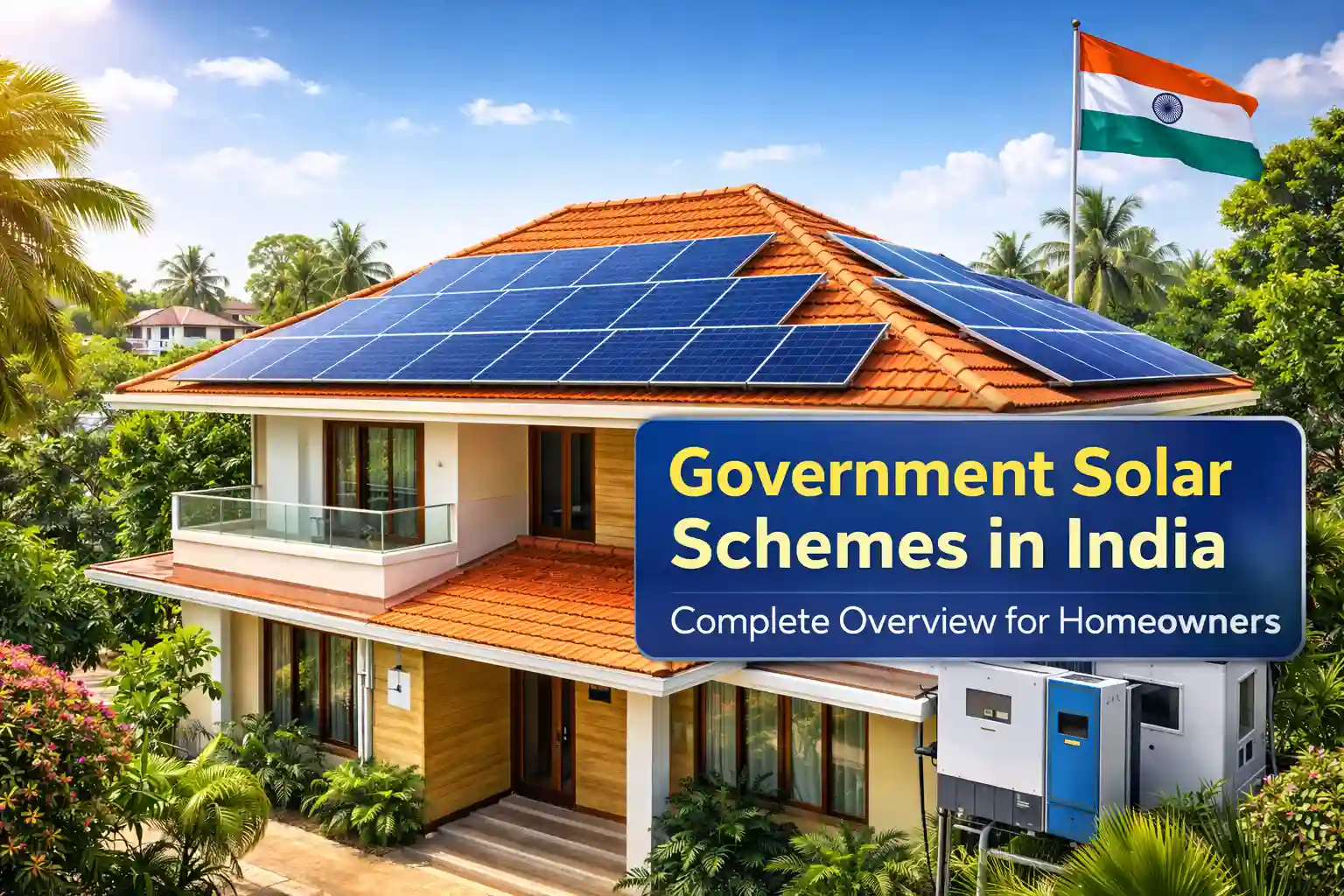
Solar energy is no longer just a clean energy idea discussed in policy documents. In India, it has become a practical household solution backed by structured government support. Over the past few years, multiple solar schemes have been introduced to help homeowners reduce electricity bills, improve energy security, and adopt rooftop solar systems with financial assistance.
However, many people still feel confused. Questions keep coming up: Which government solar scheme applies to homes? Who qualifies for free or subsidized solar panels? How does PM Surya Ghar Yojana work? And what exactly is the Kusum 2 scheme?
This guide answers all those questions clearly and calmly. No hype. No exaggerated claims. Just verified information, explained in plain English.
Why the Indian Government Actively Promotes Solar Energy
India has a strong reason to focus on solar power. The country receives abundant sunlight across most regions, making rooftop solar a logical energy option. At the same time, electricity demand continues to rise due to urban growth, appliance usage, and cooling needs.
To address these challenges, the government promotes solar energy to:
- Reduce pressure on conventional power sources
- Lower household electricity expenses
- Improve energy self reliance
- Support climate commitments through cleaner power
Most residential solar schemes fall under the policy framework of the Ministry of New and Renewable Energy, which sets technical standards, subsidy structures, and implementation guidelines.
What Is the Government Scheme for Solar Energy in India?
India does not operate a single solar scheme. Instead, it runs multiple targeted programs, each designed for a specific user group such as homeowners, farmers, or rural households.
For residential users, the main focus areas include:
- Rooftop solar installation subsidies
- Simplified net metering policies
- Financial assistance for small and medium households
- Grid connected solar adoption
Among all initiatives, rooftop solar schemes for homes have gained the most attention due to direct cost benefits.
Overview of Major Government Solar Schemes for Homeowners
Let us break down the most relevant schemes one by one, without mixing objectives.
Rooftop Solar Programme (Phase II)
This program supports grid-connected rooftop solar systems for residential buildings. It provides central financial assistance based on system capacity.
Key highlights:
- Applicable only for residential consumers
- Subsidy available for systems up to a defined capacity
- Implementation routed through state DISCOMs
This scheme laid the foundation for later, more refined programs.
PM Surya Ghar Yojana: Rooftop Solar for Households
The PM Surya Ghar Muft Bijli Yojana is currently the most discussed residential solar initiative in India.
What Is PM Surya Ghar Yojana?
PM Surya Ghar Yojana aims to provide rooftop solar systems to households with a focus on reducing monthly electricity bills. The scheme prioritizes affordability, simplified application processes, and faster installations.
The program targets a large number of homes across the country, including economically moderate households.
Which PM Surya Ghar Yojana Provides Rooftop Solar to 16.78 Lakh Households?
Official announcements and implementation updates confirm that PM Surya Ghar Yojana is the scheme designed to provide rooftop solar connections to 16.78 lakh households in its planned phases.
This target reflects the government’s intention to scale residential solar adoption rapidly while maintaining grid stability and technical compliance.
How PM Surya Ghar Yojana Works
The scheme follows a structured process rather than informal distribution.
Step-by-step flow:
- Homeowner applies through the official portal
- Roof feasibility and load capacity are assessed
- Approved vendors install the system
- Subsidy is credited after verification
Electricity generation starts immediately after grid synchronization.
Who Is Eligible for Free Solar Scheme?
The phrase “free solar” often causes confusion. In most cases, the system is heavily subsidized, not entirely free.
Eligibility generally includes:
- Indian residential electricity consumers
- Valid electricity connection
- Rooftop ownership or legal access
- Compliance with DISCOM guidelines
Certain low-income households may receive higher subsidy support depending on policy updates and state-level execution.
Eligibility conditions are defined by MNRE and implemented by state electricity distribution companies.
How Much Subsidy Is Available Under Government Solar Schemes?
Subsidy amounts depend on:
- System capacity (kW)
- Type of installation
- Household category
For small residential systems, central financial assistance significantly reduces upfront cost. State incentives may add further relief.
Exact subsidy values change periodically, so homeowners should always verify details through official portals rather than relying on third-party claims.
Net Metering: A Key Benefit for Homeowners
Most residential solar schemes work with net metering, a billing mechanism that adjusts electricity bills based on solar generation.
Here is how it helps:
- Excess solar power goes to the grid
- Exported units offset imported electricity
- Monthly bills reflect net consumption
Net metering policies are regulated by state electricity authorities under national guidelines issued by the Central Electricity Regulatory Commission.
What Is the Kusum 2 Scheme?
The Kusum scheme often appears in solar discussions, but it serves a different audience.
Understanding Kusum 2 Clearly
Kusum 2 focuses mainly on:
- Solarization of agricultural pump sets
- Grid-connected solar power generation for farmers
It does not target urban homeowners directly.
The scheme falls under the broader Pradhan Mantri Kisan Urja Suraksha evam Utthaan Mahabhiyan, which aims to support farmers through renewable energy.
Why Kusum 2 Is Not for Residential Homes
Kusum 2:
- Supports agricultural electricity infrastructure
- Works with feeder-level or pump-based installations
- Requires land or agricultural setup
Residential users should not apply under Kusum schemes unless they meet agricultural eligibility criteria.
Common Misunderstanding Between Rooftop Schemes and Kusum
Many homeowners mistakenly assume all solar subsidies fall under one umbrella. This creates confusion and failed applications.
Simple rule:
- Homes → Rooftop Solar / PM Surya Ghar
- Farms → Kusum schemes
Keeping this distinction clear saves time and effort.
State Government Role in Solar Schemes
Although the central government defines policies, states play a major role in execution.
State DISCOMs handle:
- Application processing
- Vendor empanelment
- Net meter installation
- Grid approvals
As a result, timelines and procedures may vary slightly across states.
Installation Process Under Government Solar Schemes
The installation process follows standardized technical steps.
Typical stages include:
- Site inspection
- System design approval
- Panel and inverter installation
- Safety and grid compliance checks
- Net meter activation
Government approved vendors must follow MNRE technical specifications.
Quality Standards and Safety Compliance
Government-backed solar installations follow strict guidelines.
These include:
- Certified solar panels
- Approved inverters
- Electrical safety protocols
- Performance monitoring systems
These standards protect homeowners from substandard equipment and unsafe wiring.
Maintenance Responsibility After Installation
After installation:
- The homeowner owns the system
- Basic maintenance remains the user’s responsibility
Solar systems require minimal upkeep:
- Periodic panel cleaning
- Occasional inverter checks
Most manufacturers provide long-term warranties.
Financial Impact for Homeowners
Government solar schemes aim to create predictable financial outcomes.
Benefits include:
- Lower monthly electricity bills
- Protection against tariff increases
- Long term savings over system life
Solar adoption is not about instant profits. It is about steady, measurable benefits over time.
Environmental Impact Without Overstatement
Solar power reduces dependence on fossil fuel based electricity. While one home may not change national emissions, collective adoption creates measurable impact.
Government schemes focus on scalable change rather than symbolic action.
Trusted Sources for Solar Scheme Information
Always rely on official and authoritative platforms:
- MNRE official website
- National solar portal
- State DISCOM portals
- Government press releases
Avoid relying on social media claims or unofficial agents.
Frequently Asked Questions
Is government approval mandatory for rooftop solar?
Yes. Grid-connected systems require DISCOM approval.
Can tenants apply for rooftop solar?
Only with legal permission from property owners.
Does subsidy apply after installation?
Yes. Subsidy is credited after system verification.
Final Thoughts
Government solar schemes in India are structured, regulated, and designed for long-term household benefit. They do not promise miracles. They offer logical support backed by policy, engineering standards, and financial clarity.
For homeowners, the key is understanding which scheme applies, following official procedures, and choosing approved vendors. With that approach, rooftop solar becomes a reliable household upgrade rather than a confusing investment.
When implemented correctly, these schemes quietly do what they promise: reduce bills, increase energy independence, and make solar power a practical choice for Indian homes.